Acquisitions create a strange documentation deadline. For years, your team can get away with tribal knowledge, Slack archaeology, and one engineer who knows how the billing system really works. Then a buyer shows up, diligence begins, and suddenly the codebase needs to explain itself to people who have never seen it before.
The acquiring team is not only asking, "Does the product work?" They are asking:
- What does this system actually do?
- Where are the risky parts?
- How hard will this be to maintain after the deal closes?
- Can our engineers understand it without months of hand-holding?
- What happens if key employees leave after the acquisition?
That is why acquisition-ready documentation matters. It reduces uncertainty, makes the engineering organization look mature, and helps the buyer evaluate the codebase as an asset instead of a mystery.
Why documentation becomes a diligence issue
Technical diligence is compressed. Buyers do not have six months to learn your system the way your team learned it. They have meetings, repo access, data-room artifacts, and a limited number of engineers trying to understand years of product decisions.
If documentation is missing or stale, the buyer has to infer architecture from the code alone. That creates avoidable risk. Every unclear subsystem becomes another question. Every undocumented integration becomes another follow-up. Every critical path that only one person understands becomes a retention concern.
Poor documentation rarely kills a good acquisition by itself, but it can make the process slower, more stressful, and more expensive. It also changes the tone of diligence. Instead of showing a team that operates with clarity, you force the buyer to excavate.
What buyers want to understand
Acquisition diligence documentation does not need to document every line of code. It needs to give the buyer a reliable map of the system.
Architecture
Start with the shape of the product:
- Major applications and services
- How requests move through the system
- Where background jobs, queues, or scheduled work run
- Which databases, storage systems, and external services are involved
- Which repos map to which product surfaces
The goal is not a perfect architecture textbook. The goal is for a new engineer to understand the major components and how they fit together.
Critical product flows
Buyers care most about the flows that make the business work:
- Signup and authentication
- Billing and entitlements
- Core user workflows
- Data import and export
- Notifications, webhooks, or integrations
- Admin and support operations
For each flow, document the entry point, the main services involved, the important data written or read, and the failure modes your team already knows about.
Operational knowledge
A buyer will also want to know how the system is operated:
- How deployments work
- What happens when a job fails
- How incidents are investigated
- Which dashboards or logs matter
- How environment configuration is managed
- Which manual processes still exist
This is where hidden company knowledge often lives. If only one engineer knows how to recover a failed import or rotate an integration token, write it down before diligence turns it into a fire drill.
Risk areas
Good diligence documentation is honest. It does not pretend the codebase is flawless. It identifies the areas that deserve care:
- Legacy modules
- High-complexity services
- Fragile third-party integrations
- Under-tested payment or permissions logic
- Systems with unusual deployment or recovery steps
- Features that rely on outdated assumptions
This kind of transparency builds trust. A buyer would rather see that you know where the risks are than discover them by surprise.
The acquisition documentation package
If you are preparing for acquisition diligence, build a documentation package around the questions a buyer will ask. A practical package usually includes:
- System overview: A plain-English explanation of what the product does and how the codebase is organized.
- Repo map: What each repository contains, who owns it, and what product surface it powers.
- Architecture overview: Major services, data stores, background work, and integration points.
- Critical flows: Step-by-step documentation for the product flows that drive revenue and customer value.
- Setup and deployment: How to run the system, deploy it, and recover from common failures.
- Data model notes: The important tables, entities, permissions rules, and lifecycle events.
- Known risks: Technical debt, operational gaps, and areas that need extra context.
- Current-state docs: Documentation generated from the actual code, not a stale wiki export.
The last point matters. A beautifully written Confluence page from eighteen months ago can hurt you if it contradicts the code. Diligence rewards documentation that is current.
Why manual doc sprints fail during a deal
Many teams try to solve acquisition documentation with a last-minute sprint. Everyone writes down what they know, a few senior engineers review the docs, and the company drops the result into a data room.
That can help, but it has three problems.
First, diligence happens while the company is still operating. Engineers are shipping, supporting customers, fixing bugs, and answering buyer questions. A giant manual documentation project competes with all of that.
Second, rushed documentation is uneven. The areas owned by strong writers look polished. The areas owned by busy or departing engineers remain vague.
Third, manual docs go stale immediately. If the team keeps shipping during diligence, the written package can drift from the actual code before the buyer finishes reviewing it.
The better pattern is to generate a strong baseline from the code, then have humans review and improve the parts that matter most.
How Code Summary helps companies prepare
Code Summary helps teams turn their repositories into comprehensive, current documentation without asking engineers to write every page from scratch.
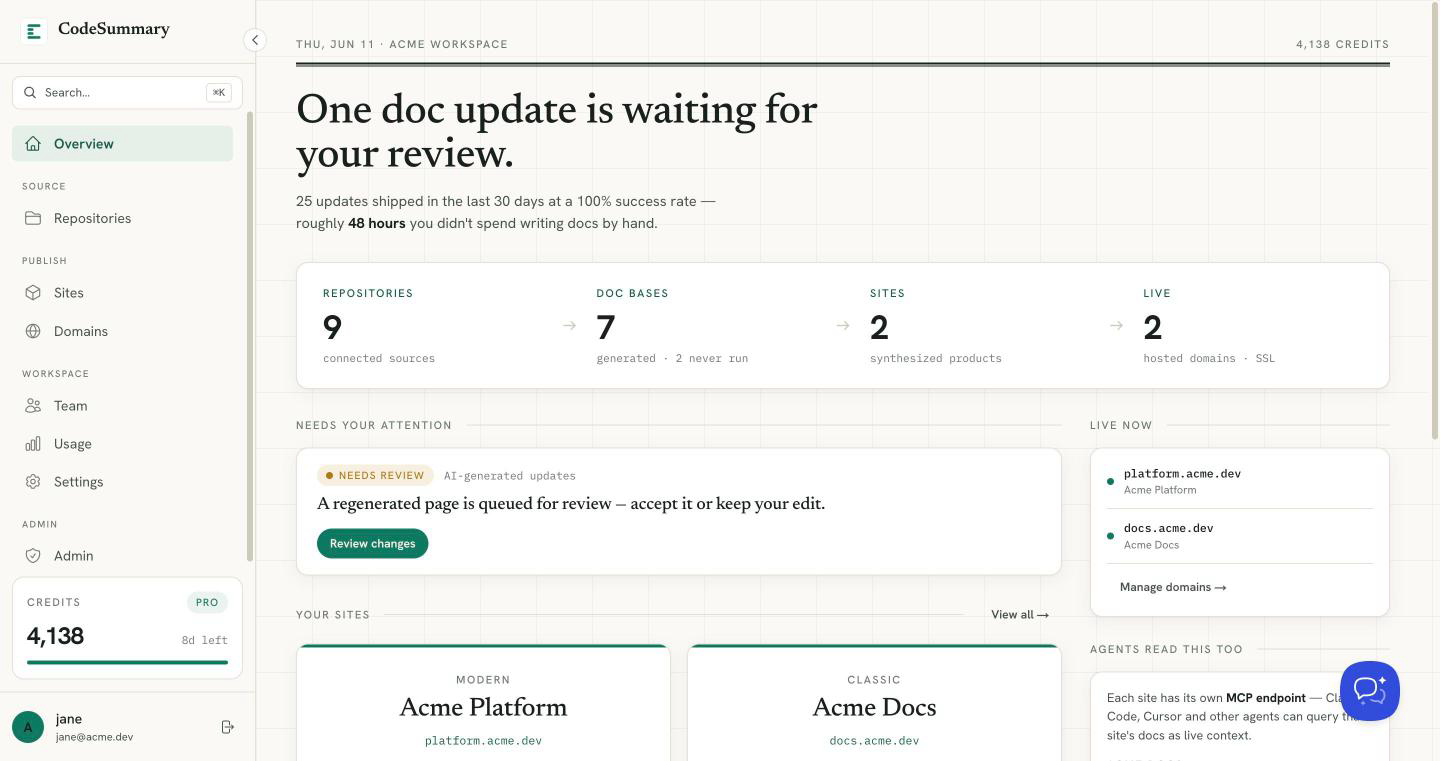
Connect the repos that matter, generate documentation from the codebase, and review the output before sharing or publishing it. As the code changes, the documentation can be regenerated so the diligence package keeps matching the product.
For an acquisition process, that means you can create:
- A repo-by-repo map of the product
- System and module overviews
- Product flow documentation
- Setup and operational notes
- Hosted docs for internal review
- Agent-readable docs for engineers using AI coding tools
It also gives your team a cleaner way to answer buyer questions. Instead of repeatedly pulling senior engineers into explanation calls, you can point diligence reviewers at a structured doc site and use meetings for the deeper questions.
Keep security and access in mind
Acquisition diligence often involves sensitive source code, customer data, and roadmap information. Documentation should make review easier without creating unnecessary exposure.
Use private docs for diligence materials, keep access limited to the right people, and review generated content before it is shared outside the company. If you publish documentation externally later, separate public product docs from private operational or architecture details.
The point is not to make everything public. The point is to make the right information understandable to the right audience.
Start before diligence starts
The best time to document for an acquisition is before a buyer asks. The second-best time is the moment conversations become serious.
You do not need to pause product work for a documentation overhaul. Start with the repos that matter most, generate a baseline, review the critical flows, and keep the docs current as engineering continues.
Acquirers are buying more than your product. They are buying the ability to maintain, extend, and trust it after the deal closes. Comprehensive documentation makes that easier to see.